Death shows up in unexpected places.
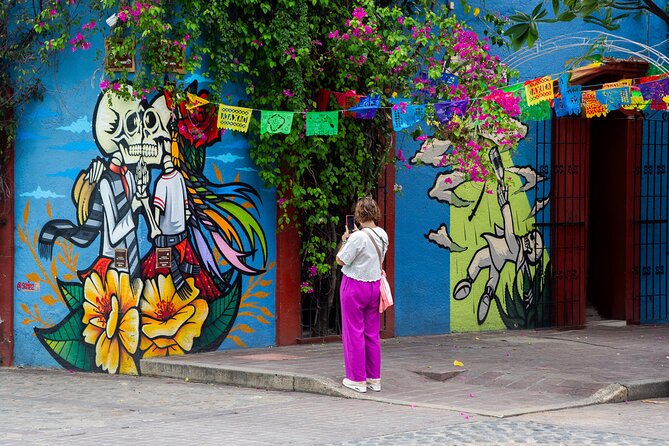
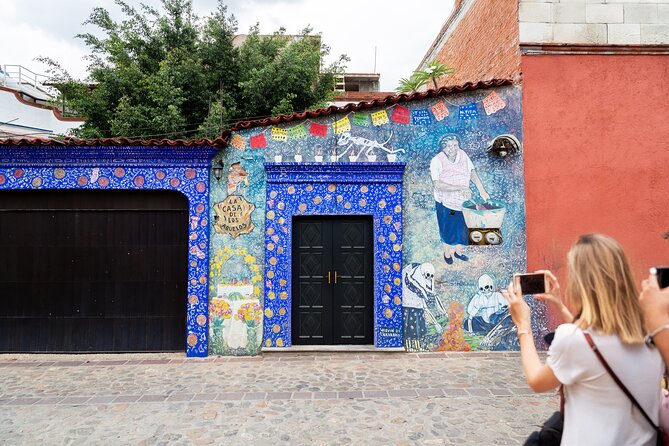
In Oaxaca City, you’ll walk through Barrio de Jalatlaco and see how death becomes art—through murals, symbols, and stories of ancestors—without turning it into a museum lecture. I especially like how the tour treats Dia de los Muertos imagery as something lived-in, not just decorative, and how the guide connects the pictures to the Oaxacan worldview.
The other big win is the guide. Juan Pablo (often called JP) explains what you’re looking at in plain language, and you come away with a working “symbol decoder” for the murals and skull motifs, including the allusive meanings you’d usually miss on your own.
One consideration: timing can get messy around the start area. A parade or local crowding can interfere with finding the group, and poor phone signal can make coordination harder, so you’ll want extra patience if the street scene gets chaotic.
In This Review
- Key Things to Know Before You Go
- Entering Barrio Jalatlaco Through Its Murals
- Stop 1: Barrio de Jalatlaco and the Art of Memory
- Juan Pablo (JP) and the “What Am I Looking At?” Advantage
- What the Murals Are Trying to Say (Without Overpromising)
- Timing, Starting Point, and How to Not Get Stuck
- Price and Value: Is $59.85 a Good Deal?
- Who Should Book This Walking Tour
- Practical Tips So You Get the Most From It
- Should You Book The Art of Death in Oaxaca?
- FAQ
- Where does The Art of Death tour begin?
- How long is the tour?
- What’s the main area you visit?
- What is included in the price?
- Is a meal included?
- Do I need admission tickets?
- What does the mobile ticket mean?
- How large is the group?
- Is the tour easy to reach with public transportation?
- What’s the cancellation policy?
Key Things to Know Before You Go
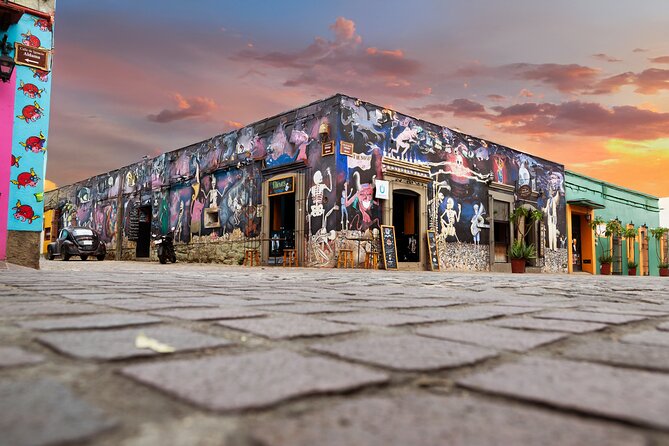
- Juan Pablo’s mural explanations focus on meaning, not just photos
- Jalatlaco’s cobblestones and adobe feel like an old village in the city
- About 1 hour 10 minutes keeps it moving, with the core walk around 50 minutes
- Small group size (max 15) means you can ask questions
- Mobile ticket—have it ready on your phone before you arrive
- Start and end at the same spot near Templo de San Matías Jalatlaco
Entering Barrio Jalatlaco Through Its Murals
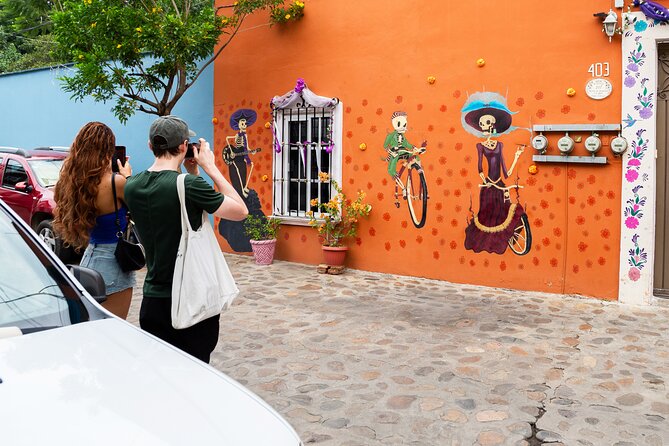
This tour works because it doesn’t treat death as scary or distant. It treats it as part of family memory, the way Oaxaca City does during Dia de los Muertos. You’re walking through an actual neighborhood, so the art isn’t stuck behind glass. It sits on real walls in real streets, and the symbolism is meant to be seen in context, not in isolation.
I like that it’s built like a story walk. You start in Barrio de Jalatlaco, a neighborhood that feels quieter and more village-like than the busiest areas of town. The setting matters. Cobblestone streets and adobe houses put you in the right mood for the idea that the living and the remembered can share the same space.
The tour also takes a “look longer” approach. You’re not just scanning murals from across the street. You slow down and learn what to notice—especially the skull images, ancestor references, and symbolic details filled with meaning. If you’re the type who enjoys art that rewards patience, this is a strong fit.
You can also read our reviews of more tours and experiences in Oaxaca City.

Stop 1: Barrio de Jalatlaco and the Art of Memory
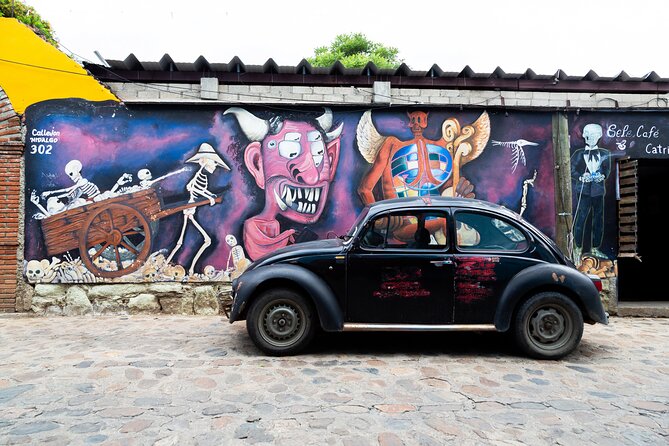
Your main stop is a one-hour walking experience through Jalatlaco, designed as an open-air museum of memory and identity. The point isn’t to check off mural after mural. The point is to understand how a neighborhood becomes a visual language for honoring the dead.
Here’s what you can expect while walking:
- You’ll move through streets lined with murals that tell stories tied to ancestry and remembrance.
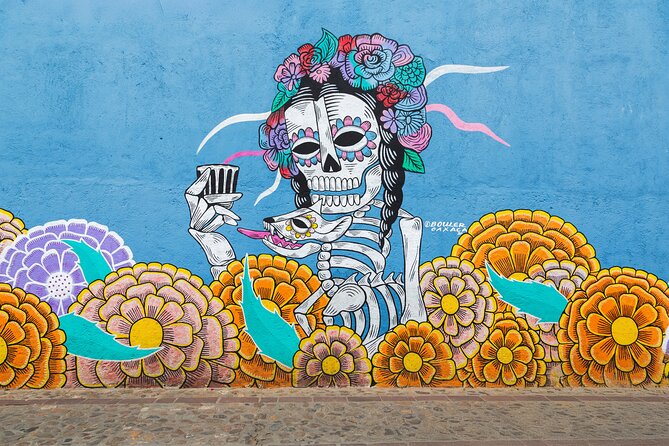
- You’ll see festive skull imagery and related symbols that are meant to carry meaning, not shock value.
- You’ll get guided interpretation of what you’re seeing and why it shows up in everyday scenes.
This is where the tour shines. Without the explanations, skull art can feel like a style you either like or don’t like. With the explanations, it becomes a set of cues—like learning the grammar of a language. You start noticing patterns: which images point to ancestors, which symbols are tied to commemoration, and how the art acts as a bridge across generations.
A practical drawback: the focus is visual, so if you’re very time-limited or prefer tours with lots of stops indoors, you might find yourself wanting more variety. On the other hand, if you enjoy wandering and want your photos to come with context, the format is perfect.
Juan Pablo (JP) and the “What Am I Looking At?” Advantage
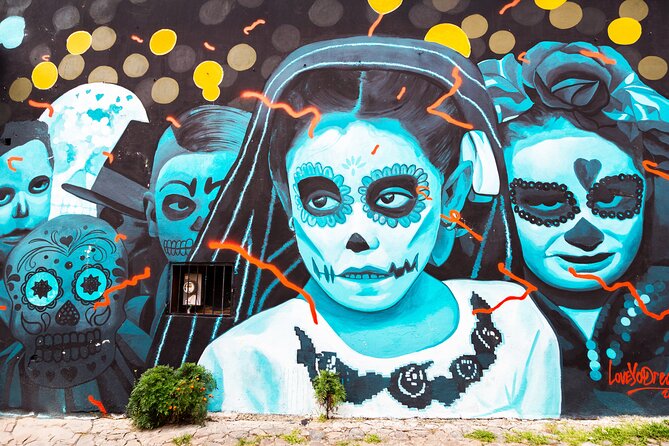
The name that keeps showing up is Juan Pablo, often referred to as JP. The praise isn’t vague. People specifically call out that he explains “allusive aspects” of the tradition and that the mural explanations are important to appreciate the artwork.
That matters because it changes how you experience the neighborhood. You’re not just taking pictures of skulls. You’re learning what makes the skulls and surrounding symbols part of a living tradition. You also get a clearer sense of how the Oaxacan worldview treats memory as something active—something you can see, walk past, and recognize.
If you’re a photographer, this style of guiding helps fast. You’ll know what’s worth framing and what’s worth slowing down for. Even if you don’t consider yourself a photographer, the same principle applies: you’ll stop “wandering randomly” and start “wandering on purpose.”
What the Murals Are Trying to Say (Without Overpromising)
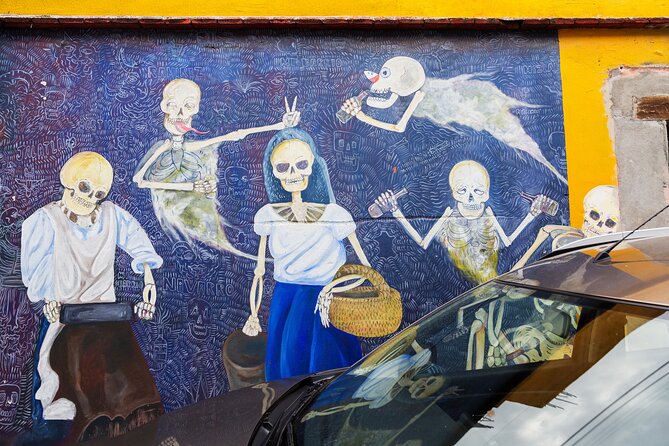
The tour is built around the idea that death becomes art at every corner. That theme can sound poetic, but the practical payoff is that you’ll leave with a grounded way to interpret what you saw.
From the tour description, you’ll focus on:
- Ancestors shown through visual storytelling
- skulls used in a festive, symbolic way
- symbols with meaning that connect art to identity and community
From the way the guide is praised, you’ll also likely get a lot of contextual explanation—enough that the artwork stops being just decoration. You don’t need to be an expert in Oaxacan culture to follow along. The explanations are described as clear and accessible, which is exactly what you want on a short walking tour.
One more honest note: the art is the main event. This is not a tour of artifacts, and it’s not a history lecture with a lot of dates. If what you want most is museum-style depth with heavy factual detail, you might find this more interpretive than academic. If you want to understand meaning and symbolism as you walk, it’s a strong match.
Timing, Starting Point, and How to Not Get Stuck
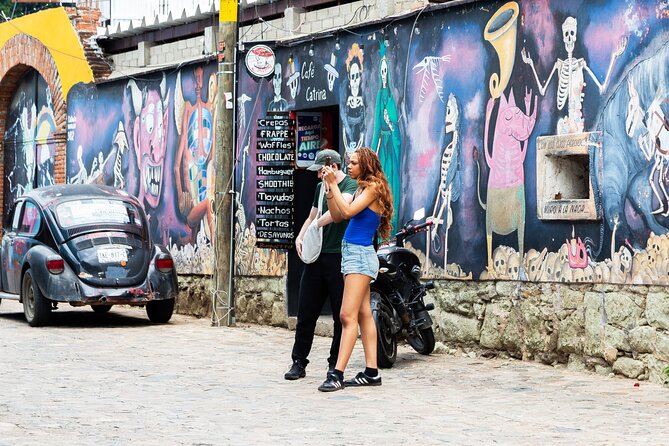
You’ll start at Templo de San Matías Jalatlaco, at Miguel Hidalgo 211, in the Barrio de Jalatlaco area. The tour ends back at the meeting point. That simple loop helps you avoid the stress of navigating a neighborhood at the end of the walk.
Duration is listed as about 1 hour 10 minutes. One of the tour details also suggests around 50 minutes of the core walking experience. So plan for an hour-ish on your feet plus the time to gather, explain, and walk between mural stops.
Group size stays small, with a maximum of 15 people. That’s a practical comfort factor. It makes it easier to hear the guide and to ask questions if something doesn’t click.
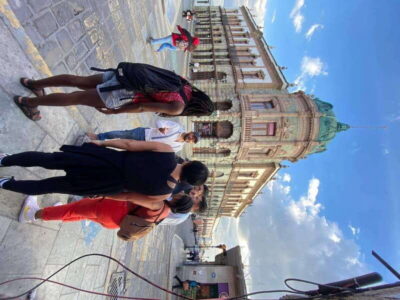
Now, the one thing to watch for: timing and street crowds near the start. There’s at least one experience where a parade caused the meeting point to be overcrowded, and the guide was hard to reach because of poor signal. You can’t control that, but you can reduce the risk.
My advice:
- Arrive a bit early so you have time to find the group at the church area.
- If you use your phone for messaging, expect that connectivity can be spotty.
- If something feels off, don’t assume the tour is cancelled—give yourself a little buffer to regroup.



Price and Value: Is $59.85 a Good Deal?
At $59.85 per person, you’re paying for a short, guided, interpretation-focused neighborhood walk. That price is easier to justify if you care about understanding art and not just photographing it.
Here’s why I think the value holds:
- You’re getting a local cultural experience, not a self-guided walk.
- The guide’s explanation is a core part of the product, and the feedback emphasizes his ability to explain the tradition’s allusions.
- The group size is capped at 15, which usually means you’re not lost in a crowd.
What could make it feel expensive? If you’re the type who doesn’t care about symbolism and prefers purely scenic wandering, you might feel like you paid for someone else to do the thinking. For that traveler, a cheaper option might work better.
But if you want to leave with actual understanding—so your photos and memories have meaning—this is priced like an experience, not just movement through the streets.
Who Should Book This Walking Tour
This tour is best for you if you:
- like street art but want the story behind it
- want a cultural experience focused on interpretation and local perspective
- enjoy small groups and a guided pace that’s long enough to connect dots
- are curious about how Dia de los Muertos shows up in everyday neighborhood visuals
It can also work well if you’re travelling solo and want something structured in a friendly way. And it’s a good option for people who want to see a real neighborhood atmosphere without committing to a full-day plan.
If you hate walking, or you expect a lot of indoor stops and seated time, you may want to skip it. The format is built for moving streets and looking closely.
Practical Tips So You Get the Most From It
A short walking tour can feel effortless, or it can feel tiring. To keep it fun:
- Wear shoes made for cobblestones. Jalatlaco’s streets are the kind you’ll notice after 20 minutes.
- Bring a phone for the mural details. Since it’s mobile ticket based, make sure you have access to your ticket on arrival.
- Bring patience. If there’s a parade or street crowding near the meeting point, the experience can slow down.
- Keep your expectations about “death as art” flexible. The tone isn’t morbid. It’s symbolic, celebratory in style, and rooted in memory.
If you do that, you’ll come out with more than images. You’ll come out knowing what you were looking at and why it matters.
Should You Book The Art of Death in Oaxaca?
I’d book it if you want a short, meaningful walk through Oaxaca City’s Jalatlaco neighborhood with a guide who can explain the mural symbolism in a way that actually helps. The strongest praise centers on Juan Pablo (JP) and the fact that the explanations are necessary for appreciating the art.
I’d hesitate only if you’re expecting a long, academic deep dive or if you’re very sensitive to schedule disruptions and crowded meeting points. In that case, you might feel the frustration more than the value.
Bottom line: if you’re open to learning the language of skulls and ancestor imagery as neighborhood art, this is a solid use of your time in Oaxaca.
FAQ
Where does The Art of Death tour begin?
It starts at Templo de San Matías Jalatlaco, Miguel Hidalgo 211, Barrio de Jalatlaco, Oaxaca de Juárez.
How long is the tour?
It’s about 1 hour 10 minutes.
What’s the main area you visit?
The experience focuses on Barrio de Jalatlaco.
What is included in the price?
The tour includes a cultural experience with a local guide.
Is a meal included?
No. Meals and drinks are not included.
Do I need admission tickets?
The information provided lists admission ticket free for the experience portion shown, and the tour includes a ticket (mobile ticket).
What does the mobile ticket mean?
You’ll have a mobile ticket for the activity.
How large is the group?
There is a maximum of 15 travelers.
Is the tour easy to reach with public transportation?
It’s near public transportation.
What’s the cancellation policy?
Free cancellation is available up to 24 hours in advance for a full refund. If you cancel less than 24 hours before, you won’t get a refund.