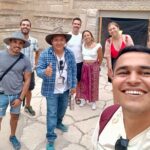
Stone pools, big trees, and real craft.
This full-day Oaxaca circuit strings together Hierve el Agua with Oaxaca’s best-known artisan traditions, from Teotitlán del Valle rugs to a working mezcal distillery. I especially love the surreal mineral pools at Hierve, where the viewpoint feels like a lookout over another planet. I also love how Teotitlán del Valle makes the craft feel hands-on, not like a sales stop.
One drawback to keep in mind: the day is long and multi-stop, so if timing slips, the later sights can feel rushed. You’ll still see a lot, but your best strategy is to be patient and expect a slightly shifting schedule.
The payoff is a compact route designed for limited time: hotel pickup/drop-off, a certified English-speaking guide, and a group capped at 40. If you want a single day that covers both scenery and Oaxaca product-making, this tour hits the main targets.
In This Review
- Key highlights worth planning around
- How this Oaxaca day tour fits together
- Hierve el Agua petrified waterfall: what you’re really looking at
- Mitla stone carvings: the Zapotec place of burials
- El Árbol del Tule: a giant cypress you have to see in person
- Teotitlán del Valle rug weaving: watching dye and loom work
- Mezcal factory: what you learn before you sip
- Price and logistics: is $85 really fair for a 9-hour day?
- What to wear and bring for Hierve + ruins + villages
- Who this tour suits best (and who might want a different option)
- Should you book this full-day Oaxaca City tour?
- FAQ
- Will I get hotel pickup and drop-off?
- What time does the tour start?
- Is the guide English-speaking?
- Are entrance fees included?
- Is lunch included in the price?
- What is the group size limit?
- Is there anything to know about Hierve el Agua in rainy season?
- Cancellation changes or refunds
Key highlights worth planning around
- Hierve el Agua’s two-level amphitheater views: lower pools with springs and irrigation, plus upper visitor facilities for sweeping sightlines.
- El Árbol del Tule’s scale: a 2,000-year-old ahuehuete cypress reported at 40 m tall and a huge 52.58 m diameter.
- Mitla’s carved Zapotec sets: you’ll see how the complex is organized into five named groups like Columns and Adobes.
- Teotitlán rugs with natural dyes: indigo, moss, and grana cochinilla are part of what you’ll hear about and see.
- Mezcal production and tasting time: you get the process behind the bottle and a chance to try it.
How this Oaxaca day tour fits together
This is one of those Oaxaca itineraries that makes sense if you’re short on days but still want variety. You start early from your hostel area (8:00 am start), then you’re out in the valley for a sequence of sights that range from jaw-dropping landscapes to craft work that explains itself.
The structure is simple: scenery first, then culture and nature (Mitla and El Tule), then craft in the village (Teotitlán), and finally a mezcal factory visit. Because entrance fees for the main stops are handled as part of the tour, you spend less time figuring out tickets and more time actually being there.
A smart way to think about value here: $85 isn’t just paying for the bus. You’re paying for a guide, transport, scheduled time at several major stops, and included visits (including a mezcal factory). Lunch is the one big extra cost to plan for.
You can also read our reviews of more city tours in Oaxaca City



Hierve el Agua petrified waterfall: what you’re really looking at
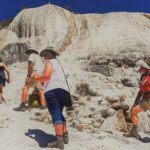
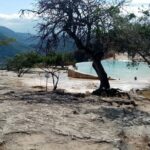
Hierve el Agua is the headline. The reason it’s so unusual is also what your guide will explain: mineral salts and a prehispanic irrigation system helped create a landscape that looks like water frozen mid-fall. Instead of flowing streams, you’re looking at petrified waterfall formations and small natural pools formed by excavating the area into what’s described as an esplanade, or amphitheater.
Plan your visit like this:
- Spend time on the amphitheater level. This is where you can take in the scenery and get that wow-factor perspective.
- Understand the two levels. The lower level relates to springs and the irrigation system; the upper level is set up for visitors.
- Watch the light and walk a bit. You’ll get different views from different angles, and that’s where the site earns its reputation.
One practical caution: Hierve el Agua is noted as closed in rainy season. If you’re traveling around that window, confirm conditions before you commit your day.
Also, the tour lists admission ticket as free for Hierve. Even if you never plan to calculate ticket math, it’s a good sign that you’re not paying extra on the spot for the main attraction.
Mitla stone carvings: the Zapotec place of burials
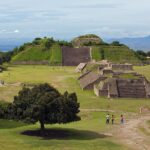
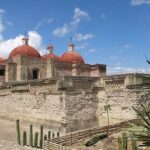
After the big scenery moment, the day turns to stone. Mitla is described as a place of residence for the Zapotec priestly class, and it shows in the way the site is laid out and named.
Here are the core details you’ll hear that help you understand what you’re seeing:
- The Nahuatl name means place of the dead.
- The Zapotec name given here is lyobaa, meaning place of burials.
- It was inhabited during the classic period of Monte Albán (100 to 650 AD) and reached its peak in the post-classical period (750 to 1521 AD).
- The layout is described as planned into five groups called Columns, the Church, the Stream, the Adobes, and the South.
If you like ruins that feel organized and readable, Mitla can be satisfying. It’s not just random stones; it’s a complex with a structure you can follow if you keep an eye on those named areas as you walk.
El Árbol del Tule: a giant cypress you have to see in person
Then you hit one of Oaxaca’s most photo-friendly nature stops: Santa María El Tule and its enormous ahuehuete cypress, El Árbol del Tule.
This tree isn’t just big in a general way. The details matter:
- reported at about 40 meters high
- reported diameter around 52.58 meters
- reported weight around 509 tons
- approximately 2,000 years old
That scale changes how you frame everything around it. Even if you’re not a “tree person,” it’s one of those stops where you instantly understand why locals treat it like a landmark, not just an attraction.
You’ll also have a chance to check out the community handcraft market and try local foods if you want. The tour keeps your time moving, but it gives you a foothold to interact with daily life rather than only visiting monuments.
Teotitlán del Valle rug weaving: watching dye and loom work
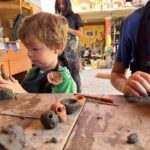
Teotitlán del Valle is where the tour becomes about making things, not just looking. This town is where woolen rugs are made on domestic looms, and the craft story comes through because you visit an artisan’s house to see the process.
You’ll hear about natural dyes that include indigo, moss, and grana cochinilla. Those names aren’t just trivia. They help explain why Oaxaca textiles can look so varied even when the designs follow familiar patterns.
When you’re watching the process, I’d focus on three things:
- The dye workflow. Even if you don’t know the chemistry, you can notice how color changes depend on materials and timing.
- The loom method. Domestic looms show the craft as manual and skill-based, not as mass-produced output.
- The design logic. If you look closely, many textiles feel like repeatable systems—border logic, central motifs, and color placement that makes the whole piece readable.
There’s also typically time for browsing, and the tour offers chances to buy woven goods. From what’s been observed, the sales pressure tends to be low. You can look without feeling rushed.
You can also read our reviews of more tours and experiences in Oaxaca City

Mezcal factory: what you learn before you sip
The last major stop is a mezcal factory visit, and this is where the tour taps into a huge part of Oaxaca identity: agave-based spirits.
You’ll get context that makes the tasting more interesting:
- mezcal is derived from the agave plant
- tequila is the more famous cousin, but mezcal is described as less known and just as potent
- it’s been gaining popularity beyond Mexico (the tour notes international attention, including major media coverage)
They frame it as both education and experience. You’ll learn how mezcal is made, then you’re encouraged to try it. The tour also includes a Spanish saying tied to mezcal: Para todo mal, mezcal, y para todo bien, también.
Even if you don’t plan to buy a bottle, this stop can still be worth it because you leave with a better sense of what you’re tasting. If you do buy, set expectations: mezcal bottles can vary a lot by producer and style, so look for clear labels and explanations from the person at the factory.
Price and logistics: is $85 really fair for a 9-hour day?
$85 for a full-day tour can look like a lot until you break down what you’re actually getting. Based on what’s included, you’re covering:
- transportation
- accommodation pickup and drop-off
- a certified English-speaking guide
- included visits to Hierve el Agua, Teotitlán del Valle, Mitla, and the mezcal factory
- entrance fees for the stops handled by the tour
The big extra is lunch: a buffet is listed at 150 pesos. So your real all-in cost depends on whether you add lunch from the tour menu or eat on your own.
Timing is the other side of the value coin. The day is long, and you’re stacking multiple major sites plus village visits. When a multi-stop route is run tightly, you feel like you’re getting a highlights reel. When it runs less tightly, the risk is that you’ll reach later stops with less flexible time for exploring.
So I’d plan your expectations like this: you’ll see a lot, but you should stay flexible. Bring a good mood, water if you can, and a light layer for comfort on the road.
Group size matters too. With a cap of 40, this isn’t a tiny private outing, but it also isn’t a giant cattle-car situation. You should still be able to hear explanations and move with the group.
What to wear and bring for Hierve + ruins + villages
No one likes to pack for a day that’s half viewpoint, half workshop. Here’s what I’d personally prioritize based on the kinds of stops included here:
- Comfortable walking shoes for uneven outdoor terrain (ruins and viewpoints are not flat showroom floors)
- Sunscreen and a hat, especially if you’ll be at Hierve el Agua during peak daylight
- A small bottle of water
- Cash or a card-ready setup for lunch (buffet is listed at 150 pesos) and optional purchases
If you’re sensitive to long rides, consider planning small breaks for your legs. Between stops, you’ll likely get a few minutes to reset, but this is still a 9-hour day.
Who this tour suits best (and who might want a different option)
This tour is a great fit if you want a single day that checks off several top Oaxaca experiences without doing route planning. It also works well if you care about craft processes, not only finished products.
You’ll probably enjoy it most if:
- you’re visiting Oaxaca City with limited time
- you want both scenery and handicraft culture
- you prefer a guided explanation at multiple stops
It may be less ideal if you hate time pressure. Because Hierve el Agua is weather-sensitive and the day includes several locations, you’ll want to be comfortable adjusting to the flow of the day rather than demanding perfect timing at every hour.
Should you book this full-day Oaxaca City tour?
My honest take: book it if you want an efficient, well-rounded day that combines a surreal natural wonder with real artisan visits and a mezcal factory stop. The included transport, guide, and entrance coverage at several major sites make the $85 price feel practical rather than inflated.
I’d think twice if you’re the type who needs a very strict schedule. This route has enough moving parts that delays can compress the later part of your day. If you can handle that, you’ll likely come away feeling like you packed in the core Oaxaca highlights.
If you’re booking close to rainy season, double-check whether Hierve el Agua is operating. Missing the main site would change the whole value of the day.
FAQ
Will I get hotel pickup and drop-off?
Yes. The tour includes accommodation pickup and drop-off in Oaxaca City.
What time does the tour start?
It starts at 8:00 am.
Is the guide English-speaking?
Yes. The tour provides a certified English-speaking guide.
Are entrance fees included?
Yes. Entrance fees are included for Hierve el Agua, Mitla, Teotitlán del Valle, and the mezcal factory.
Is lunch included in the price?
No. A buffet lunch is not included, and it’s listed at 150 pesos.
What is the group size limit?
The tour has a maximum of 40 travelers.
Is there anything to know about Hierve el Agua in rainy season?
Hierve el Agua is noted as closed in rainy season, so it may not be available depending on weather.
Cancellation changes or refunds
This experience is non-refundable and cannot be changed for any reason. If you cancel, the amount you paid will not be refunded.